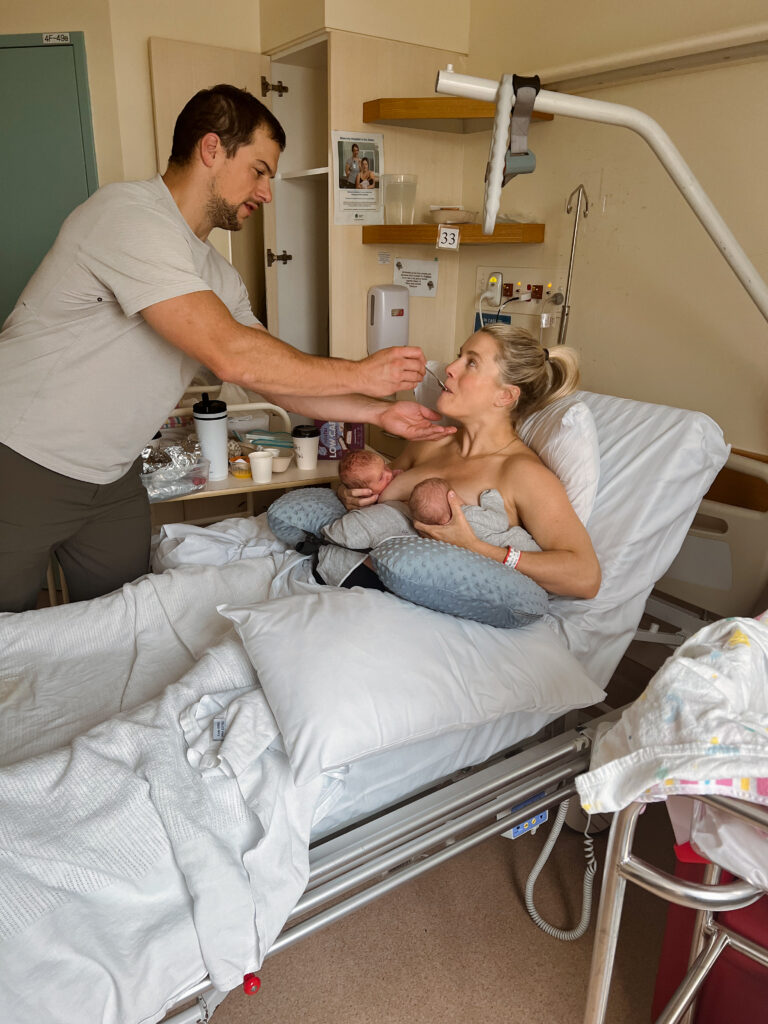
Lucy story is one of resilience, vulnerability, and the profound transformation that comes with motherhood. As a former collegiate track and field athlete turned perinatal exercise specialist, Lucy brings a unique perspective to the conversation about birth, recovery, and the intersection of athletic identity with maternal experience.
Lucy’s journey began with what she describes as her “cute pregnancy” with Ocean. Having worked in the perinatal training space for a decade, she felt confident in her preparation. “I was one of those people testing like five days before you can test and just thinking I was pregnant every time,” Lucy recalls of her conception journey, which took six to eight months.
Her athletic background initially seemed like an advantage. “I’d printed out all of these mantras and all these things that I wanted to repeat to myself. I’d also told Max, I’d printed out all of these things that I wanted Max to say,” she explains. However, this meticulous preparation would later work against her when birth didn’t follow her carefully laid plans.
At 42+2 weeks, after extensive monitoring and multiple interventions, Lucy found herself facing an emergency caesarean. “I essentially was not dilating. The baby started to, Ocean started to go into distress. They weren’t able to stop my contractions,” she describes the escalating situation.
The athletic mentality that had served her so well in sport became a source of self-criticism: “Naturally as an athlete I thought my god I did not try hard enough… if I’d only held on longer if I’d only tried harder.” This internal dialogue reflects a common struggle among high-achieving women who approach birth with the same goal-oriented mindset they apply to other areas of life.
The Unexpected Twin Journey
Lucy’s second pregnancy brought immediate surprises. “I was sick before I knew it was twins,” she shares, describing debilitating nausea that made teaching fitness classes nearly impossible. “I’d get like a feeling like I was gonna puke and I’d just move the mic away, have a moment, put the mic back.”
The discovery of twins at the dating scan was both shocking and amusing: “She hovered and she’d gone quiet and then we were just like waiting and she was like one baby and then she just said two babies there’s two babies in here. Max drove on the wrong side of the road when we left that appointment because he was like so thrown.”
Birth Trauma and Medical Emergency
The planned caesarean for the twins began peacefully, with Lucy playing Matt Corby music and feeling prepared. Koa’s birth was straightforward, but Maddox’s arrival became a medical emergency that would haunt the family for months.
“When they pulled out Maddox he just didn’t look right. So he was born actually unresponsive, like not breathing. So he was a code blue and they pulled him out and I just remember looking at him and being like, he’s not right. Like something’s not right. He just looked dead.”
The trauma of watching medical staff perform chest compressions on her newborn son, while being immobilised on the operating table, created lasting emotional scars. “I was lying down and I couldn’t see, I just knew that they’d taken him away. And all they kept saying to me was like, look at your beautiful girl… And I just remember being like, I’m looking at her, but in my head being like, are you well? Like, of course I’m not just looking at my little girl. I don’t know if Maddox is okay.”
The Ongoing Impact of Birth Trauma
Lucy’s honesty about the lasting effects of birth trauma is particularly powerful. She admits she still cannot look at the photos taken immediately after Maddox’s birth: “I cannot look at the ones of Maddox because he just doesn’t look right and it kind of brings back too many feelings.”
The experience has created a heightened anxiety around Maddox’s health that persists today. “I feel with my girls because my girls are just, they’re just, I’ve never had a moment of such sheer panic about them that it almost feels like with Maddox I’m like, I’m protective of all my kids but I feel this kind of like, is he okay?”
Redefining Body Image and Recovery
As someone whose body had always been used for sport and performance, Lucy’s relationship with her post-birth body required significant adjustment. After her first caesarean, she struggled with disappointment and self-criticism. However, her experience with twins brought a different perspective.
“My scar with after I had Ocean, was very like, I was quite thrown by it I didn’t expect it. But this time around, my scar’s the least of my worries, to be honest,” she reflects. The physical changes from carrying twins – particularly the skin elasticity – presented new challenges, but also opportunities for growth.
Lucy has found healing through vulnerability, sharing her post-birth body openly online: “Showing my skin and me pulling it and me playing with it and showing how it is, what it is online has almost helped me in a way. Like it’s kind of like showing that the things that society thinks is imperfect has made me embrace it a little bit more versus like hiding it.”
Professional and Personal Integration
Working in the perinatal space while navigating her own challenging pregnancies and births gave Lucy unique insights. Her twin pregnancy, in particular, provided firsthand experience of challenges she’d only observed professionally: “The twin pregnancy opened my eyes more to, you know, when women speak about needing to wear a supportive belt or women speak about feeling lightheaded lying on their back… it meant that the videos that I was taking, I just had a lot more to speak about because I was firsthand going through those challenges.”
The Reality of Multiple Parenting
Lucy’s candid discussion of life with three children under four, including twins, provides valuable insight for families considering their options. “We have no family support in Australia. So like we have nobody that helps out with anything. We have a beautiful nanny that comes on Saturday mornings for a few hours and that is essentially outside of daycare… that is our village.”
The logistical challenges of feeding twins particularly resonated: “I made enough breast milk for one and a half babies not quite two so I needed extra support… I’ve never felt more like a cow in my entire life than with the twins. Like I just felt like if I wasn’t getting them on the same cycle… I was just feeding all day.”
Looking Forward
Despite the challenges, Lucy’s story is ultimately one of resilience and growth. Her experience has deepened her empathy for the women she works with and strengthened her relationship with her partner Max, who provided crucial support during their most difficult moments.
When asked about future children, Lucy remains open but realistic: “I’ll give myself like a second to just catch my breath and we will reassess… it’s either happening in the next few years or like I’m happy to be like, all right, let’s move on now.”
Key Takeaways for Expectant Parents
Lucy’s story offers several important lessons for expectant parents, particularly those with athletic backgrounds or high-achieving personalities:
- Preparation doesn’t guarantee outcomes: While birth education is valuable, flexibility and acceptance are equally important
- Athletic mindset can be both helpful and harmful: The same drive that creates sporting success can lead to self-criticism when birth doesn’t go to plan
- Birth trauma affects partners too: Max’s experience watching the medical emergency unfold was equally traumatic but often overlooked
- Recovery is individual: What works for one birth may not apply to subsequent experiences
- Professional knowledge doesn’t eliminate emotional responses: Even experts in the field can struggle with their own experiences
- Vulnerability can be healing: Sharing struggles openly can help both the storyteller and their audience
Lucy’s journey reminds us that birth is unpredictable, recovery is complex, and healing often comes through connection and shared experience. Her willingness to share both the triumphs and traumas of her motherhood journey provides invaluable support for other parents navigating similar challenges.
If you’re struggling with birth trauma or perinatal mental health challenges, remember that support is available. Contact PANDA (Perinatal Anxiety and Depression Australia) on 1300 726 306 or visit panda.org.au for resources and support.

Topics Discussed
IVF, Caesarean
Episode Sponsor
Motherhood is powerful. Birth recovery deserves to be too. Your recovery matters as much as your pregnancy – that’s why Bare Mum exists.
Bare Mum creates thoughtfully designed birth and recovery essentials to support you through the fourth trimester and beyond
From soothing peri bottles and cooling inserts to comfortable postpartum briefs, recovery kits, and breastfeeding support products – everything is designed with the mother at the centre.
Bare Mum is also proudly endorsed by the Australian College of Midwives and the Australian Physiotherapy Association, so you know it’s trusted by the professionals supporting you too.
Explore the full range of birth, recovery and breastfeeding essentials at baremum.com.
-
The Birth Class
$249.00The empowering online childbirth education program that will help you confidently prepare for birth.


