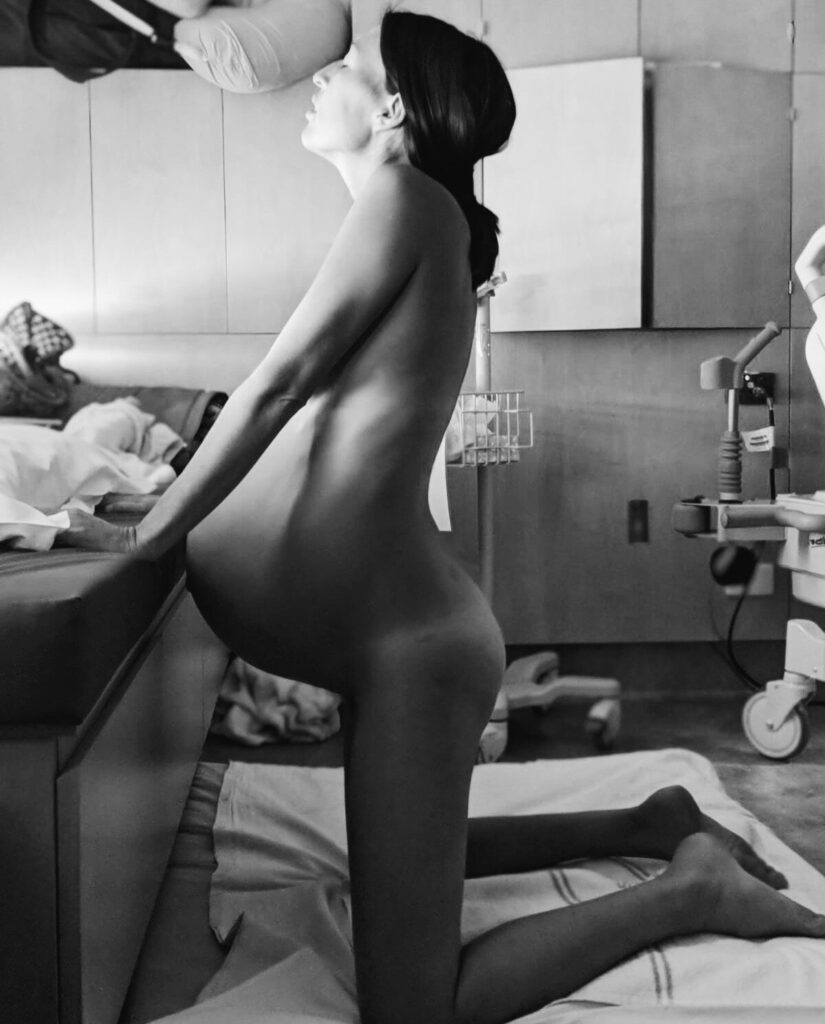
In this episode, Hana takes us through the emotional rollercoaster of discovering she was carrying twins, navigating a high-risk pregnancy with fortnightly scans monitoring for twin-to-twin transfusion syndrome, finding an obstetrician who genuinely supported her wish for a vaginal birth without an epidural, and ultimately birthing both girls — including a breech second twin — in hospital at thirty-seven weeks. She also speaks honestly about the postpartum period with four children under four, the power of community and a well-organised meal train, and what it really looks like to tandem feed twins in those early weeks.
This episode is for anyone navigating a twin pregnancy, hoping for a vaginal twin birth, or simply needing a reminder that advocating for yourself and finding the right care provider can make all the difference.
Hana lives in Byron Bay with her husband Jeremy and their four children — Zephyr (four), Dali (two), and one-month-old identical twin girls, Mika and Bobby. Alongside motherhood, she and her sister run an organic, plant-dyed muslin label making baby wraps, cot sheets and more.
Hana’s first two births had been deeply positive experiences. Zephyr was born at home in Sydney with a private midwife in a water birth that lasted around eight hours. “It was really great,” she recalls. “It was everything you could want.” Her second birth with Dali through the Byron homebirth programme was a very different story — two hours from first contraction to baby, with the midwives arriving just twenty minutes before he was born. “Jeremy was running around the house trying to heat pots of water on the stovetop,” she laughs. “The noises I was making were completely different to the noises I was making with Zephyr. It was like the eight hours compacted into two hours.”
The Shock of Two
Hana fell pregnant with her third baby while on a family road trip around Western Australia. She’d been feeling more tired than usual but put it down to camping, toddlers, and sausage rolls. It wasn’t until her thirteen-week scan — which she’d delayed until returning to Byron — that everything changed. “She said, ‘There’s actually two in there,’ and I just couldn’t even comprehend it. I just started crying from shock. And Jeremy goes, ‘Are you sure?’ And she said, ‘Let’s just make sure there’s not a third in there.’ And I almost vomited on her.”
Jeremy was thrilled. Hana needed a moment alone in the van. “He was so happy and so excited and I was just… you know, you don’t have to carry them. What if I can’t carry them to full term? And then I’m going to have four kids under four at home with me.”
The twins were confirmed as identical and monochorionic — sharing a single placenta — which meant fortnightly tertiary scans in Southport to monitor for twin-to-twin transfusion syndrome (TTTS) and intrauterine growth restriction. Hana explains TTTS clearly for listeners: “Because they’re sharing the placenta, one twin can get, say, forty percent and the other sixty percent. Twin-to-twin is when there are blood vessels that run all the way across the placenta and transfer blood from each of the twins to each other — that’s when you can have problems.” Once she reached twenty-eight weeks and the girls were tracking well, she successfully pushed to reduce the frequency of scans.
Finding the Right Care Provider
Because twins are classified as high risk, Hana was no longer eligible for the Byron homebirth programme. She chose to birth at Lismore Hospital under a private obstetrician with admitting rights — meaning she received private care within the public system. But finding him wasn’t straightforward. Everything she read suggested that vaginal twin births required an epidural, and she struggled to find stories of women who had done it without one. “I searched and searched and I could not find women’s stories of them having a vaginal birth without an epidural. I got pretty upset because I was like, no. This is my last birth. I don’t know how to give birth with an epidural. My body doesn’t know.”
When she finally met her obstetrician and told him she didn’t want an epidural, his response was simple: “Okay, cool. If that’s what you want to do, we’re not going to make you.” That was the moment everything shifted. “He was really like an old midwife, which was just what I wanted. I wanted someone that was there but wasn’t really there at all.”
The Birth
At thirty-seven weeks, Hana attended a routine appointment and was found to be six centimetres dilated — without being in active labour. Her obstetrician, concerned about the hour-long drive home and Hana’s history of fast births, strongly encouraged her to stay local. Twin B, Bobby, had also flipped back to breech. Hana and Jeremy spent the night at a nearby motel, hoping labour would start on its own. It didn’t. The following morning, a stretch and sweep brought her to eight centimetres, and contractions began building shortly after.
Her sister and close friend Amy arrived at the hospital — both with their own five-month-old babies in tow — along with Jeremy, the midwives, her obstetrician, and a paediatric team. “It was a pretty packed room towards the end,” Hana says warmly.
She laboured standing for most of it, leaning into Jeremy between contractions. After a period of rest on the floor and some quiet time in the darkened bathroom with Jeremy, she made the call to have her waters broken. Forty-five minutes later, Mika was born — caught by Jeremy, exactly as they’d hoped. “He caught her, which was something we’d spoken about that I wanted him to do.”
With Mika’s cord cut and Jeremy taking her skin-to-skin, Hana’s obstetrician confirmed Bobby was still breech. Hana moved onto her back and, with one arm briefly stuck beside her head, Bobby was born feet first. “It was like you don’t have that pressure from the body, and then you’ve got the pressure of this head that you’re pushing out. It was so wild.” Amy cut Bobby’s cord. “It just worked out so well. It was a really beautiful birth.”
The Fourth Trimester
Bobby’s blood sugars dropped after birth and she spent one night in the nursery with Jeremy doing skin-to-skin throughout. Hana’s sister and Amy pumped milk on the spot and at home, ensuring Bobby received donor breastmilk rather than formula through that first night. “It was so special — just to have my sister and Amy there, and that all of that milk went to her.”
The family were home by the following evening. Hana’s parents live around the corner, her sister organised a meal train, and her community showed up with bone broth, collagen-rich stews, ghee, and lasagnas. “All my girlfriends are very passionate about postpartum care,” she says. “It was all very, you know, bone broth.” She didn’t leave the house for four weeks. “I love doing it. I love this period. I’m healing. My body expanded hugely and then all of a sudden it’s empty — just healing that and resting.”
On tandem feeding twins, Hana is refreshingly honest: “I’ve kind of just been letting them run their own programme. And then the last few nights I’ve thought, okay, something’s got to change.” She’s taking it one day at a time. “If I think about him going back to work and me having all four kids — that’s when it becomes overwhelming. But as long as I’m just doing today, everything’s pretty good.”
For Midwives, Doulas and Expectant Mothers
Hana’s story is a powerful reminder that twin pregnancies do not automatically mean a caesarean, an epidural, or a loss of autonomy. It takes research, advocacy, and the right care provider — but it is possible. “Find the doctors that support you,” she says. “It’s your body and it’s your birth. They’re there to work with you.”


Topics Discussed
postpartum village, no epidural, breech second twin, breastfeeding twins, Vaginal twin birth, Identical Twins
Episode Sponsor
If you’re expecting, creating your dream nursery, or looking for premium baby essentials, now is the perfect time to shop at iL Tutto because our EOFY Sale starts at 9am on Tuesday 16 June.
iL Tutto is Australia’s destination for beautifully designed nursing chairs, recliners, bassinets, CoZee co-sleepers, cots, nursery furniture and baby sleep essentials, created to support families from pregnancy through to parenthood and even beyond!
During the EOFY Sale, you can save up to 40% off sitewide, plus we’ve got an exclusive offer just for the ABS audience. Use code ABS5 at checkout for an additional 5% off sale prices.
There are some incredible savings available. Like the Felix Glider Chair and Recliner in Sea Shell is 40% off, and the Maya Electric Recliner & Glider in our best-selling Eggshell fabric is also 40% off. Then, with our exclusive ABS5 code, you’ll save even more.
If you’ve been thinking about investing in a nursing chair, bassinet or nursery furniture, this is one of the biggest sales of the year.
But don’t wait too long, the iL Tutto EOFY Sale ends 1 July 2026.
Shop online at iLTutto.com.au and don’t forget to use code ABS5 for your extra savings. * excludes online bundles.
-
Birth Meditations
$49.00Narrated by Sophie Walker, these soothing and informative meditations help you feel supported and confident around birth.


