As a doula who has supported over 150 births, including nine vaginal twin births, Lauren brings both professional insight and deeply personal experience to this conversation.
Her twin pregnancy and birth story is particularly compelling – growing two babies to singleton size despite her petite frame, navigating the medical system with confidence, and ultimately achieving the gentle water birth she envisioned. This episode is packed with practical wisdom about precipitous labour, twin pregnancy, building a birth support team, and balancing motherhood with a calling to support other birthing families.
Lauren’s story begins with that familiar longing for motherhood and a big family – a dream that would eventually see her welcome six beautiful children. As an only child herself, she’d always envisioned creating the bustling household she’d never experienced, and her journey certainly delivered on that vision.
Early Births and the Birth of a Birth Worker
Lauren’s first pregnancy at 22 took six months to achieve, which felt like an eternity at the time. “I was one of those people testing like five days before you can test and just thinking I was pregnant every time,” she recalls with a laugh. Her first birth experience would prove to be the catalyst for everything that followed – a precipitous labour that saw her go from 3cm to fully dilated in just 45 minutes.
“I remember absolutely breaking down. It was the worst news possible. I was like, how in this many hours have I only dilated one centimetre and I begged for an epidural,” Lauren shares about that moment of despair at 3cm. But within 45 minutes of arriving at the birth suite, she was fully dilated and ready to push. “I remember feeling like superwoman. I remember thinking, there is nothing that I can’t do. Throw a challenge at me.”
This transformative experience planted the seeds for Lauren’s future career. “I remember thinking that I wanted to be a midwife. That was really the first kind of… And I actually had applied to study midwifery when after my second was born.”
The Reality of Precipitous Labour
Lauren’s second birth was even quicker – just three hours from start to finish. “I woke up at three thirty in the morning and he was born at six thirty. So it was very quick,” she explains. But rather than feeling empowered, this birth left her feeling like she’d been hit by “this freight train that you’re trying to jump onto.”
This experience highlights an important reality about precipitous labour that’s often overlooked. “I think anyone who’s had a really fast experience also is kind of thinking, six hours is like the sweet spot. Anything shorter than that is a little bit too quick.”
Finding Her Calling as a Doula
After four children, Lauren finally found her path into birth work as a doula. “When she was about 12 months is when I really started to think that it was possible for me to be able to leave the house for extended periods of time. Obviously you have no idea how long somebody’s labour is gonna be, and so you need to be able to say, see you later, no idea when I’m gonna be home.”
Her work as a doula became deeply fulfilling, though it required careful boundary setting. “When you first start out, it’s however long you need me, I’m gonna be there. And pretty quickly I think you realise that it’s not sustainable.” Lauren learned to implement 12-hour limits and strategic breaks, essential for longevity in this demanding but rewarding field.
The Twin Surprise
Lauren’s sixth pregnancy brought the ultimate surprise – identical twins. “Never in a million years did I think that I was gonna have twins. I just was never something that even crossed my mind,” she shares. The discovery came at their eight-week scan: “Immediately she put the wand under my belly and I could see that there was more than one.”
The sonographer’s careful examination revealed MCDA twins (monochorionic diamniotic) – sharing one placenta but having separate amniotic sacs. “We looked at each other and we just cracked up laughing, like almost hysterically like laughing because we were just like, this is… This doesn’t happen.”
Navigating Twin Pregnancy
At just 160cm tall, Lauren faced the physical challenge of growing two babies to singleton size. “They grew as singletons right up until the very end. But it just meant that I was absolutely massive. I think my belly ended up measuring 50 at the end.”
The physical demands were immense. “I actually outgrew all of my pregnancy clothes as well. Like you buy maternity clothes. They did not accommodate a twin bump at all.” The public attention became overwhelming: “I remember saying to my partner, actually, I can’t go to the shops anymore because when I walk around, everyone stares at me and it makes me feel so uncomfortable.”
Building the Dream Team
Lauren’s approach to twin birth care was methodical and informed. She assembled what she calls her “epic dream team” – private midwife Joe Hunter, her trusted doula Samantha Gunn, and a supportive obstetrician who respected her birth preferences.
“One thing that I was really conscious of was being really open with all of my care team about what I wanted and having those discussions really early, not leaving anything to chance,” Lauren explains. Her preferences included delayed cord clamping for both babies, water birth, and avoiding routine interventions like epidural or continuous monitoring beyond what was medically necessary.
The Twin Birth
Lauren’s twin birth story reads like a birth worker’s dream. After her waters were broken at 8:30am, labour didn’t establish until 11:30am. “I didn’t get my first contraction until like eleven thirty. And in that whole time I was like, oh, it’s not even happening.”
Once labour established, things progressed beautifully. She laboured on a mat with fairy lights, using her TENS machine and favourite music. “I tend to go very internal when I’m in labour. I’m a very low kind of stimulus person when I’m in labour.”
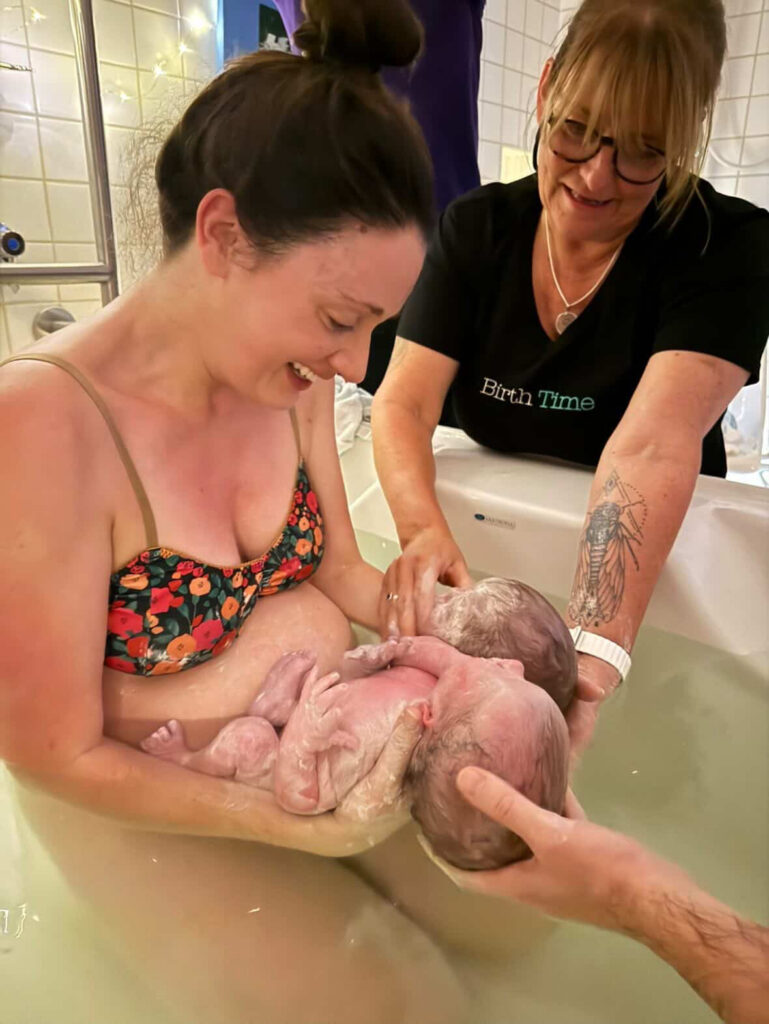
The water birth she’d envisioned became reality. Twin A was born at 3pm, and remarkably, twin B followed just six minutes later. “I remember sitting there… holding my little twin in front of me… And I remember feeling down and I just felt this sack coming out of me, this huge bulging sack.”
Twin B was born still in his membranes, which broke as his body emerged. “He just kind of slid out in like one go. It was really nothing. There was no pushing or… He just kind of slid out in his sack still.”
The Importance of Physiological Third Stage
Despite recommendations for a managed third stage due to twin birth risks, Lauren chose a physiological approach. “I decided not to have a managed third stage. I wanted to have a physiological third stage.” Her blood loss was estimated at just 100ml – remarkable for any birth, let alone twins.
The placenta, weighing over a kilogram, took 45 minutes to birth. “That was actually probably harder than twin birth, to be honest. Like it took some pushing to get that thing out.”
Postpartum and Beyond
Lauren’s recovery was swift, and the family was home before bedtime, much to the relief of her anxious eldest daughter. “We walked in… we surprised them… and yeah, they were so excited to see their little brothers. And the relief flooding off me of, oh my goodness, now, you know, we’re not having to stay. There’s no NICU time.”
At three months postpartum, Lauren is already back on call for select doula clients, demonstrating the passion that drives many birth workers. “I get called birth junkies… You get addicted to that post oxytocin high, that kind of just, by osmosis goes to everybody in the room and it’s electric.”
Wisdom for Families and Birth Workers
Lauren’s story offers profound insights for both families planning births and birth workers building their practices. Her emphasis on early, honest communication with care providers, the importance of assembling a supportive team, and trusting in the body’s ability to birth – even twins – provides hope and practical guidance.
For those experiencing precipitous labour, Lauren’s journey shows both the challenges and the empowerment that can come from these intense experiences. Her transition from overwhelmed mother to confident birth worker illustrates how our birth experiences can become the foundation for supporting others.
“I felt like I was able to support people. Just felt, it felt really nice to have something that was actually just mine rather than being in that mum role,” Lauren reflects on finding her identity as a doula whilst mothering her growing family.
Lauren’s story is ultimately one of trust – trust in her body, trust in her babies, and trust in the birth process itself. From her first precipitous labour to her gentle twin water birth, she demonstrates that with the right support, preparation, and mindset, even the most challenging birth scenarios can unfold beautifully.


Topics Discussed
IVF, Caesarean
Episode Sponsor
-
The Birth Bundle
$349.00This Bundle includes The Birth Class, Discovering Motherhood and our Breastfeeding Guide.


