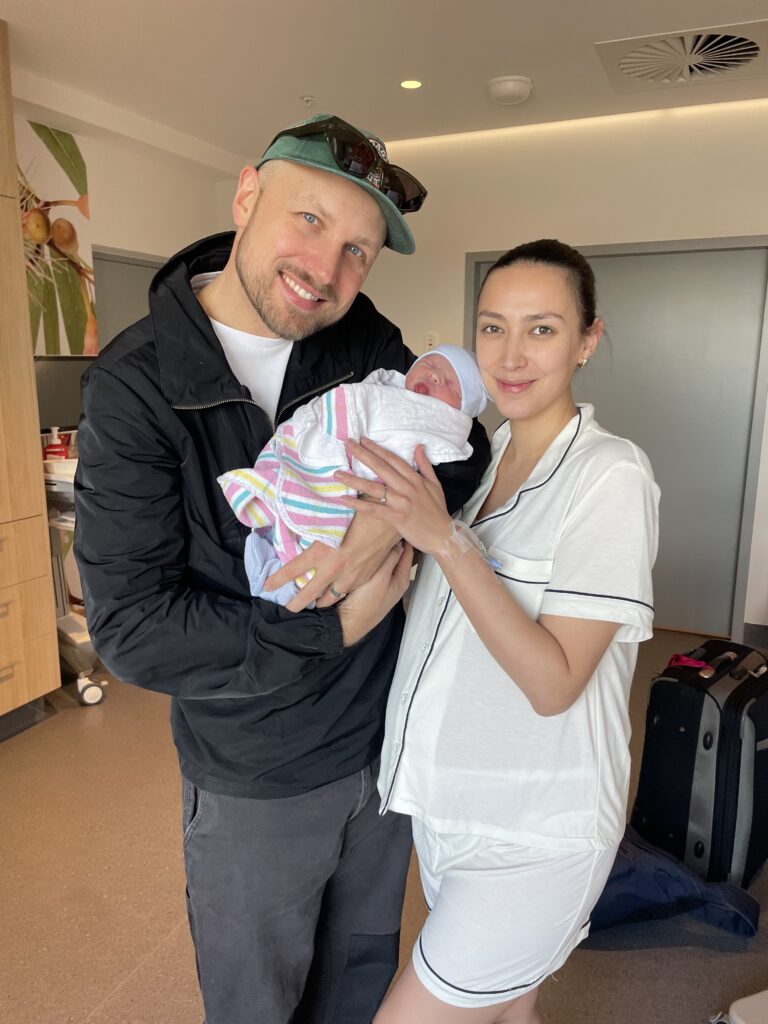
Estelle’s story begins with what she describes as a “beautiful dream of being a mum in my mid twenties,” but like many women, her path to motherhood didn’t unfold as expected. After two years of trying to conceive naturally, she and her husband sought fertility help and discovered she had Graves disease (hyperthyroidism), though her diagnosis remained unexplained infertility.
The IVF Journey
Estelle’s candid account of her IVF experience reveals the emotional complexity many women face during fertility treatment. “I found that whole process quite scary,” she admits. A pivotal moment came during mandatory counselling when the counsellor gave her permission to grieve: “It’s okay to be sad that you are in this club of women who have to seek help.” This validation allowed Estelle to acknowledge her feelings rather than trying to appear as the “perfect potential mum.”
The secrecy surrounding her treatment added additional stress. “I told no one,” Estelle reflects. “I think it fed into me being embarrassed or ashamed.” She describes the challenge of juggling a high-pressure TV journalism career with the demands of IVF – blood tests, timing, injections – whilst being on call for breaking news stories. Looking back, she recognises: “If I’d go back in time, I should have not assumed that people would have judged me or that my work wouldn’t have been supportive.”
Her first embryo transfer failed, which she found devastating despite telling herself it would work first time. Fortunately, her second transfer was successful, creating six embryos from her cycle. The positive result was “mind blowing” after such a long journey, though anxiety continued throughout pregnancy.
First Pregnancy and Birth
Estelle’s first pregnancy was marked by significant anxiety and secrecy. She didn’t tell anyone, including her parents, until nearly five months along. “I was worried what she might think about me doing IVF,” she explains about her religious mother, though her mum’s reaction was pure joy when she finally shared the news.
Her waters broke at 38 weeks, leading to induction after two days of partial leaking. “I really just want contractions to start because I want to go into labor naturally,” she recalls, though admits: “Looking back, I don’t know why I wanted to do that… it probably was a relief when I went into the hospital… and they said, we’re going to induce you.”
The birth experience was positive despite some challenges. When contractions intensified quickly with the drip, Estelle initially tried to downplay her discomfort: “I found that the contractions came on quite strongly, quite quickly… I was in agony and the midwife and my husband saying, are you okay? And I was like, I’m fine.” Eventually she accepted an epidural and describes feeling immediate relief, allowing her to “come back to earth” and prepare for pushing.
A significant moment came when her original obstetrician fell ill and was replaced by a female doctor. “For this moment where I’m actually gonna do this incredible female thing, how good is it to be surrounded by women?” This experience influenced her choice for subsequent care.
Postpartum Challenges
Estelle’s honesty about her immediate postpartum experience is refreshing. “I didn’t get the rush of love immediately,” she admits. “I more had a sense of what is going on… I was obviously ecstatic, but I didn’t feel that feeling that I thought so many people say that you will absolutely feel.”
The real challenges began with breastfeeding. An interaction with an older midwife devastated her confidence: “What are you doing? She’s not even feeding. Like that’s not even a latch… my heart just deflated. And I thought, oh my God, she’s right. Like, I don’t know what I’m doing.” This led to significant anxiety and daily calls to support lines for months.
Despite these challenges, Estelle persevered with breastfeeding for seven months, though she “never truly enjoyed it.” Her experience highlights how one negative interaction can profoundly impact a mother’s confidence and mental health.
Second Pregnancy: An Unexpected Gift
In a remarkable turn of events, whilst preparing for another IVF cycle, Estelle conceived naturally. “For the first time in my life, I took a pregnancy test spontaneously and it was positive, which was the craziest thing to me.” The timing was particularly poignant as she was scheduled for an endometrial scratch to prepare for embryo transfer.
This unexpected pregnancy brought different anxieties. Having planned for a lengthy IVF process, the immediate conception felt overwhelming. “We won’t be having a child for ages. So to do a test and realize, oh, it’s already happened. That scared me.”
Second Birth: A Redemptive Experience
Estelle’s second birth was markedly different. She chose induction again, but this time requested the epidural first: “I’ve done it before. I don’t need to do it again… we actually did the epidural first and once the epidural had kicked in, then we induced.” This approach allowed her to focus on the emotional experience rather than managing pain.
The birth was calm and positive. “I did feel a rush of love this time,” she shares, “because being an anxious person, I like to know what I’m preparing for… this time I knew what would happen.”
Feeding Choices and Mental Health
Perhaps most significantly, Estelle made the decision to formula feed her second child from the start. “Because of my experience with breastfeeding the first time around, I just decided to go to formula. Not because my body can’t feed, but because I just think like, I didn’t want to get back into that head space.”
This decision, whilst initially causing some uncertainty, ultimately supported her mental health: “I really felt like my second postpartum period was like a do-over for me… this massive weight of feeding and being the only person to settle wasn’t there.”
Current Challenges and Growth
Six months postpartum with her second child, Estelle faces new challenges including her son’s severe eczema and ongoing sleep deprivation. She’s honest about experiencing “rage” during night wakings, recognising: “I get very stressed out to the point of being angry when it’s the middle of the night.”
However, she’s developed better coping mechanisms and is considering professional support: “Being a mom really is probably the best and most challenging thing I’ve ever done. So I think if there’s ever a time for me to speak to someone about things that are hard for me, it would be now.”
Key Takeaways
Estelle’s story powerfully illustrates several important themes:
- Fertility struggles affect identity: “IVF was a massive part of my identity when I was going through it”
- The importance of support: Recognising that secrecy often makes challenges harder
- Birth experiences can vary dramatically: Even with the same woman and similar circumstances
- Feeding choices should support maternal wellbeing: “I want to be a good mom. And I feel like the way that I was in the first few months of motherhood with my first, I was so in my head that I wasn’t very present”
- Trusting maternal instincts develops over time: Learning to make decisions that work for your family rather than following prescribed expectations
Estelle’s journey reminds us that there’s no single “right” way to become a mother, and that sometimes the most loving thing we can do is make choices that support our mental health and family wellbeing, even when they differ from societal expectations or our own initial plans.