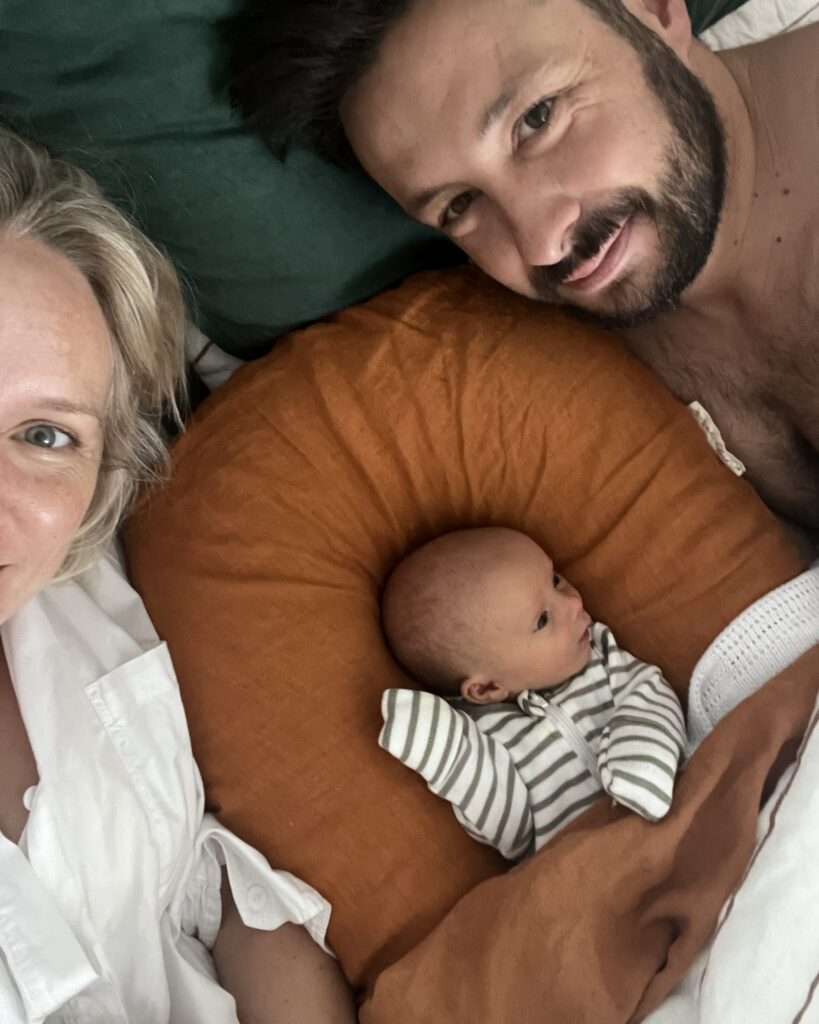
Serrin’s story begins like many others – a graphic designer living in beautiful Byron Bay with her partner Tom, who works for the World Surf League. After being diagnosed with adenomyosis and initially fearing fertility challenges, they were delighted to conceive quickly. However, what started as typical first-trimester symptoms soon became something far more serious.
“I started getting these like excruciating headaches and migraines and lots of nausea because of that. Every day I was so tired as well. I remember every day trying to go and just try and do some work and just try and get through the day. I was just so tired and depleted and it was really exhausting,” Serrin recalls of her early pregnancy symptoms.
Initially dismissed as normal pregnancy-related changes due to increased blood volume, Serrin’s severe headaches were actually warning signs of a much more serious condition. During a trip to Margaret River at around 15 weeks, her symptoms dramatically worsened.
“I woke up with the most excruciating headache in the back of my head, it was really coming from the base of my skull. That evening I got really unwell and started vomiting and then overnight it just wouldn’t stop. I felt like a pop or something when I was vomiting and assumed I had just pulled a muscle.”
What Serrin experienced was likely a small brain bleed – a warning sign of what was to come. Despite multiple visits to Byron Hospital over the following weeks, her symptoms were consistently attributed to pregnancy-related issues. The turning point came when a different doctor finally took her seriously.
“On the last time I went, there was a different doctor there and he was like, ‘Hang on a second, so you’ve been in here this many times this week, you haven’t improved.’ He gave me a steroid and said if that doesn’t improve your condition, you need to go to Tweed and get a scan tomorrow.”
The steroid provided temporary relief, but at 22 weeks pregnant, Serrin experienced a major subarachnoid haemorrhage whilst at home alone. “All I can remember is going to get a coffee, and then I essentially woke up and my next memory is of being in a hospital bed, in a hospital that I hadn’t been to.”
The diagnosis was devastating yet enlightening: Serrin had an arteriovenous malformation (AVM) – a cluster of incorrectly connected blood vessels in her brain. “Someone explained it to me as think of a five-lane highway going into a country road. The increased blood volume of pregnancy is like traffic surging along these roads and it’s got nowhere to go, so the traffic spills out.”
The medical team at Gold Coast University Hospital faced a critical decision. At 22 weeks, Bobby wasn’t considered viable, and emergency surgery to drain the blood would have meant delivering the baby. Miraculously, Serrin’s body began naturally draining the blood into her spinal fluid.
“Fortunately, the blood started draining itself, which was quite handy. They were like, ‘Okay, so we won’t have to operate on you because it could have been fatal for both you and the baby.'”
Serrin spent two weeks in ICU followed by time on the neurology ward, with little memory of this period. “I have like snippets of it, but I can’t remember most of it. I think by the end I can remember more – I was up playing Monopoly Deal, beating everyone, which was my superpower at the time.”
The pregnancy continued under intensive monitoring, with Serrin unable to return home to Byron Bay due to the risk of another bleed. “We couldn’t go home because that was over the border. If something were to happen whilst I was in New South Wales, I would get triaged in a New South Wales hospital and none of them would be able to treat me properly.”
Living in Airbnbs on the Gold Coast, supported by an incredible GoFundMe campaign organised by friends, Serrin navigated the remainder of her pregnancy with regular monitoring and strict medication protocols. “I wasn’t allowed to take anything that could thin my blood because that was a really high risk of causing another rupture. I wasn’t even allowed to drink plain water – I had to keep my sodium levels up with salt tablets.”
At 38 weeks, Bobby was delivered via planned caesarean section. “There was never a question of what I wanted. I think in my whole birth experience, the one choice I had was what playlist we were going to play.” Despite the lack of choice, Serrin found peace in trusting her medical team completely.
“I honestly had this feeling – if they turned around and said we’re going to have to cut off every finger and sew them to your eyebrows, I would’ve been like, ‘Go for it, I trust you with my life.’ There was this really nice surrendering of just being like, ‘I trust you all, you know what you’re doing.'”
The birth itself was supported by Sophie, their midwife navigator, who had been instrumental throughout the pregnancy. “We were really fortunate that Sophie came to the birth with us. I’m just so grateful that she was there because I had never seen any of those people before in the room, and I think that would be really scary if I hadn’t had her there.”
Bobby arrived healthy, but Serrin’s medical journey was far from over. Initially told she would need immediate post-birth surgery, the timeline was extended as her condition remained stable. However, when Bobby was six months old, Serrin underwent a complex embolisation procedure to block off the AVM using a glue-like substance called Onyx.
“They feed in a catheter through this little hole in my hand and up into your brain, and they put out this glue solution. It essentially blocks off all of those irregular formations so blood won’t go through it and cause problems again.”
Tragically, Serrin experienced another brain bleed during recovery from this procedure. “That night I was in ICU and I started to feel really unwell with these crazy headaches again. I was like, ‘Oh my God, it’s happening again.’ I had what’s called a perioperative bleed – another brain bleed whilst I was in ICU.”
This setback meant another two weeks in hospital when Bobby was just six months old, presenting new challenges for the family. “I think we were both very much of the mindset that this was the final chapter in that story, life’s going back to normal. Now knowing what was happening after that whole series of events, we were only halfway through it.”
Recovery was gradual, with Serrin experiencing memory issues and other cognitive challenges. “The only thing that I struggle with now is if you said, ‘Serrin, I’ll give you $1 million if you give me detailed instructions to get from your house to Wategos Beach,’ I’d be like, ‘I just can’t do that.’ I just struggle with some orientation stuff and that’s it.”
Despite everything, Serrin’s perspective on life has been profoundly transformed. “I feel like I’ve been given this second chance of life. I know that sounds really dramatic, but I feel like it’s a gift and I really want to use that gift to the best of my ability.”
The experience has also opened unexpected possibilities. Initially told she shouldn’t have another baby, recent medical reviews have been more optimistic. “I was very much like, ‘We can just have one, I’m savouring every moment.’ And then he called and said, ‘There’s nothing to say at this point in time that you couldn’t have another baby.’ That just opened up another door.”
Serrin’s story is a powerful reminder of the importance of advocating for yourself during pregnancy, trusting your instincts when something doesn’t feel right, and the incredible strength that can emerge from the most challenging circumstances. Her journey also highlights the vital role of community support and excellent medical care in navigating high-risk pregnancies.
For expectant mothers, midwives, and doulas, Serrin’s experience underscores the complexity of pregnancy complications and the importance of persistent advocacy when symptoms don’t align with typical pregnancy experiences. Her story is ultimately one of hope, resilience, and the extraordinary capacity of both the human body and spirit to overcome seemingly impossible odds.


Topics Discussed
AVM rupture, brain bleed in pregnancy, Caesarean, Gold Coast University Hospital
Episode Sponsor
To celebrate the release of iL Tutto’s newest award-winning Frankie Electric Recliner, listeners of Australian Birth Stories can enjoy an exclusive 20% off the iL Tutto Trend Collection for a limited time.
iL Tutto creates beautifully designed nursery furniture that supports parents through every stage, from those first days at home to life beyond the nursery.
Their ever-growing premium Trend Collection brings together thoughtfully designed, sustainable timber cots and chests, alongside award-winning nursing chairs, including the much-loved Frankie and Louie in Teddy-Fleece and Corduroy.
And now, iL Tutto has welcomed the newest addition to the collection, the award-winning Frankie Chair in Soft Teddy-Fleece, available in two stylish, trend-led colours designed to elevate your nursery and live beautifully in your home long after the baby years.
To celebrate, enjoy 20% off iL Tutto’s Trend Collection for a limited time. Simply use the code ABS20 at iltutto.com.au.
This offer ends 25 March, 2026. Conditions apply.
iL Tutto, designed for comfort, made to last.
-
Birth Meditations
$49.00Narrated by Sophie Walker, these soothing and informative meditations help you feel supported and confident around birth.


