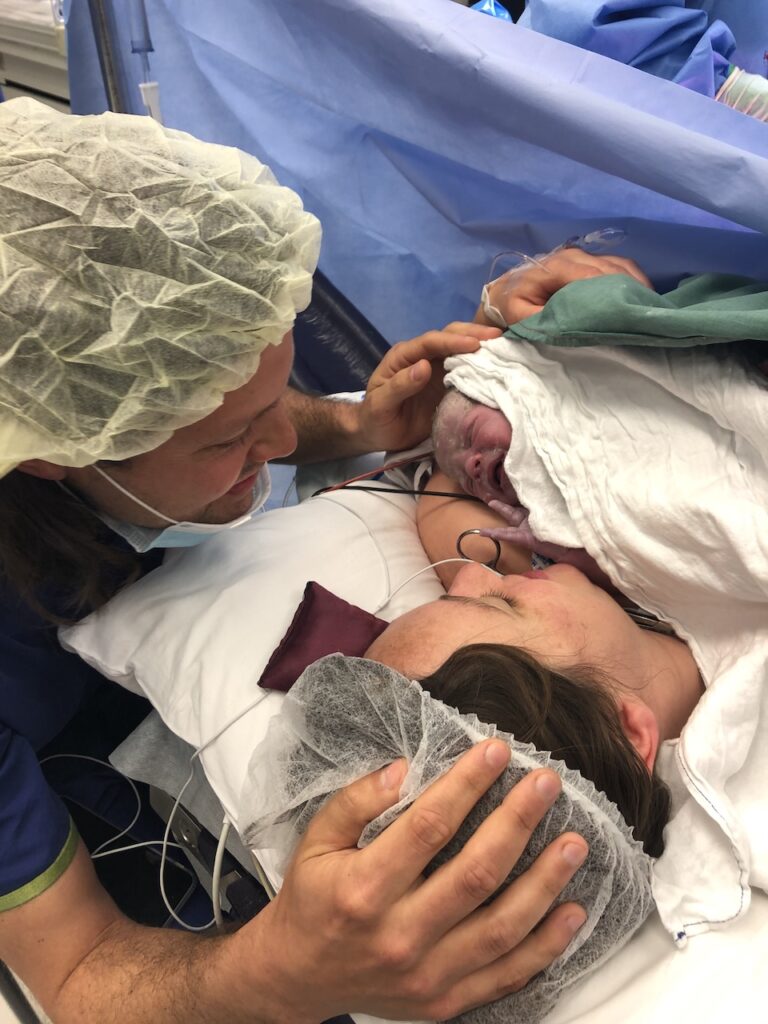
Amy’s story begins in January 2020 when she conceived her first child, Maggie, on the first try – a surprise that would set the stage for an extraordinary journey through motherhood during one of the most challenging periods in recent history. As a clothing designer running her own business in Melbourne, Amy thought she understood what lay ahead. She couldn’t have been more wrong.
The COVID Pregnancy Experience
“I fell pregnant on the first cycle. We decided to go with a private obstetrician because I wanted continuity of care,” Amy recalls. What followed was a pregnancy unlike any other, shaped by the unprecedented restrictions of COVID-19 Melbourne. The couple found themselves navigating a healthcare system in flux, where rules changed daily and support systems crumbled overnight.
Amy’s journey took a dramatic turn when, after initially preparing for a home birth through the Sunshine Hospital programme, a routine 30-week scan revealed major placenta praevia. “The lady that was the sonographer that was checking everything she’s ‘oh, this is a disaster, placenta. This is, oh my gosh. Not a chance. You’re gonna birth naturally,'” Amy remembers of that devastating appointment she attended alone due to COVID restrictions.
From Home Birth Dreams to Caesarean Reality
The diagnosis meant an immediate shift from natural birth preparation to scheduled caesarean at 38 weeks, along with six to eight weeks of bed rest. Despite having no symptoms of placenta praevia – no spotting or warning signs – Amy found herself in the high-risk category, constantly checking for blood and living with anxiety about her baby’s safety.
Her caesarean birth at the Mercy Hospital was medically successful but emotionally challenging. “I felt like I wasn’t really that present because the drugs really do kick in and yeah, you, it will happen so quickly as well,” she reflects. The clinical nature of the experience, combined with limited partner access due to COVID restrictions, left Amy feeling disconnected from what should have been a joyful moment.
The Breastfeeding Struggle
Amy’s postnatal experience was marked by significant breastfeeding challenges that would set the tone for her early motherhood. Despite successfully latching in recovery, once on the ward, “I didn’t have one midwife try and latch Maggie on. I was just handed a pump straight away.” The lack of support, combined with understaffing during COVID, meant Amy spent four days largely alone, struggling to establish feeding whilst recovering from major surgery.
The triple-feeding cycle that followed – pumping, bottle feeding, and topping up with formula – lasted six weeks and pushed Amy to her limits. “I was put on that pump feed bottle feed, whatever. That’s. Whatever that cycle is, the round the clock, three hours. So I would pump, we would feed her that milk, then we would top her up,” she explains. It wasn’t until an independent lactation consultant provided home support that Amy found her way to successful exclusive breastfeeding.
The PMDD Discovery
Perhaps the most significant part of Amy’s story begins when her menstrual cycle returned at seven months postpartum. What followed was a gradual descent into what she initially thought was postpartum depression and anxiety, but which would later be diagnosed as premenstrual dysphoric disorder (PMDD).
“I would say from then on things started to unravel very slowly,” Amy explains. The family’s move to Tasmania, driven by pandemic pressures and work opportunities, coincided with increasingly severe mood symptoms. “Lots of rage, so lots of just angry outbursts, lots of uncontrollable crying, and you just don’t, you just think, oh, I have postpartum depression, I have postpartum anxiety.”
The cyclical nature of her symptoms initially went unrecognised. Amy describes having “these weeks where I feel completely fine, completely normal. I’m loving life… And then it would just be like a switch.” The pattern of feeling well for about a week, followed by two weeks of severe symptoms, dominated her life for months.
The Turning Point
Amy’s lowest point came with intrusive thoughts of self-harm. “I would be like walking the dog and think maybe I could just like jump in front of that car… these intrusive thoughts that I was like, this is not me.” It was during this crisis that she and her partner discovered PMDD through online research, finally finding an explanation for her cyclical suffering.
“I started tracking my cycle and yeah, lo and behold it was like I would ovulate and then it would start, and then I would get my period and then it would go,” she explains. However, getting a proper diagnosis took two years, as most GPs were unfamiliar with the condition.
The Healing Journey
Amy’s path to healing involved multiple approaches: finding knowledgeable healthcare providers, building a support team, and crucially, doing deep work around her birth trauma and transition to motherhood. Working with a postpartum doula became transformative: “I decided to start speaking to a postpartum doula who is like a godsend… I had to start my postpartum again.”
This work involved processing Maggie’s birth experience, accepting her role as a mother, and preparing for the possibility of another child. “I saw a pelvic health physio, I saw, I started to get therapy. I saw a postpartum doula, and I think I saw her for probably about a year of doing all that work, which in hindsight was, I guess like preconception journey.”
The Transformative Second Birth
Amy’s second pregnancy with Kip was approached with intention and preparation. Despite initial resistance from her GP about private midwifery care and VBAC plans, Amy advocated for herself and chose home birth with continuity of care. “I knew I couldn’t have control of the birth, but I was like I knew how hard that was. Not having my midwife in my postpartum with Maggie.”
After 39 hours from waters breaking to birth, Kip was born at home in water – a healing experience that restored Amy’s faith in her body. “Birthing him in the water at a home was just, yeah, like I was pushing for about an hour and a half… he was born and he was screaming and tiny and slimy and just amazing.”
Life After PMDD Diagnosis
Today, Amy manages her PMDD through lifestyle modifications, cycle tracking, and family support. “I would say I have a couple of rocky days. It’s not po, it’s not two weeks of my month anymore,” she explains. The extreme thoughts have calmed, and she’s developed tools to work with her cycle rather than against it.
Her relationship with her partner has strengthened through understanding and teamwork. They use a rating system on difficult days, and he provides practical support during her luteal phase. “We got into a routine where I would, he’s tell me a number today. Write on the fridge. Like, where are you today? Are you a two out of 10? A US seven?”
Key Takeaways for Listeners:
Amy’s story offers several crucial insights for pregnant women, new mothers, and birth professionals:
- PMDD is real and treatable – Many women suffer in silence, thinking severe premenstrual symptoms are normal or part of postpartum depression
- Birth trauma can manifest in unexpected ways – Even “successful” births can leave emotional wounds that need addressing
- Postpartum support is crucial – The quality of postnatal care can significantly impact long-term wellbeing
- Advocacy in healthcare is essential – Women must be prepared to seek out knowledgeable providers and fight for appropriate care
- Healing is possible – With proper support and understanding, women can overcome significant challenges and find their power
Amy’s journey from isolation and despair to healing and empowerment demonstrates the resilience of mothers and the importance of comprehensive, woman-centred care throughout the childbearing years.
If you’re struggling with severe premenstrual symptoms or birth trauma, please reach out to qualified healthcare providers. PANDA (Perinatal Anxiety and Depression Australia) offers support for parents experiencing mental health challenges.
This episode of Australian Birth Stories is brought to you by iL Tutto, the brand loved by parents for creating beautiful, functional, and comfortable nursery furniture and essentials.
Their Black Friday Sale is now live, from November 18 through to December 1, with up to 50% off sitewide.
You’ll find amazing offers like 50% off Felix Gliders and Ottomans in Egg Shell, 50% off Felix Electric and Manual Chairs in Sea Shell, 40% off selected cots and chests including Misha, Kuba, and Hallee, and 20% off Grow Kindly Sleepwear.
Plus, as an exclusive offer for Australian Birth Stories listeners, you’ll get an extra 5% off when you use the code ABS5 at checkout.
Hurry — these offers end Monday, December 1 at 11:59pm.
Shop now at iltutto.com.au
T&Cs apply. Excludes the Trend Collection and furniture packs.


-
The Birth Class
$249.00The empowering online childbirth education program that will help you confidently prepare for birth.


