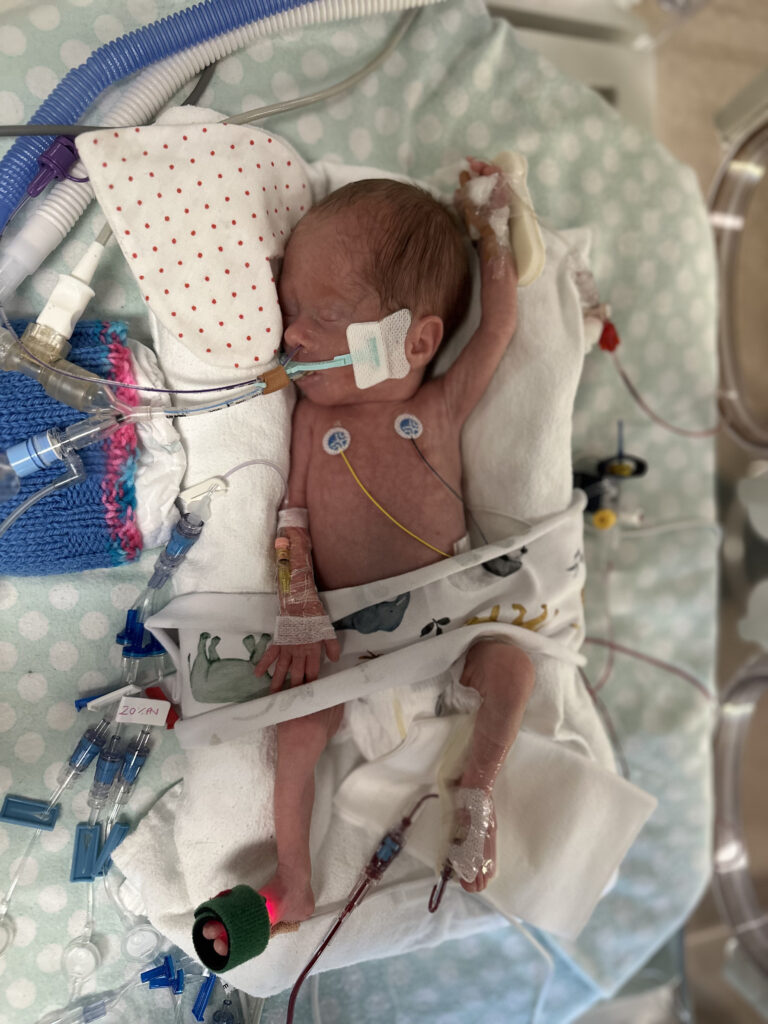
Brittany’s story begins with the all-too-familiar struggle of conception. At 33, with time feeling precious and AMH levels indicating potential fertility challenges, she and her husband Braden tried for 18 months before conceiving naturally. “I wasn’t one of these people who was desperate to become a mum. I still didn’t know fully how I felt about becoming a mum. I quite enjoyed our single life adventuring together,” Brittany reflects honestly about her feelings towards motherhood.
The early pregnancy proceeded relatively normally, with Brittany experiencing the overwhelming fatigue that catches so many first-time mothers off guard. “I worked from home and so my lunch breaks, I would lie down on the floor and just take a nap. And then straight after work, I would be back in bed having a nap. I was just wrecked for the first trimester.”
The First Warning Signs
At the 20-week scan, the first concerns emerged. Brittany was diagnosed with a two-vessel umbilical cord, and Teller’s legs were measuring in the 13th percentile. However, it wasn’t until 28 weeks that the full extent of the complications became clear. “They told me that he was measuring in the first or below the first percentile for his weight,” Brittany recalls of that pivotal appointment that changed everything.
The diagnosis was comprehensive and frightening: IUGR, FLIP markers indicating impending preeclampsia, absent diastolic flow through the umbilical cord, and CMV infection markers. “I was really adamant to not be stressed throughout the pregnancy… But from that point on, it was like, oh, okay, this baby is actually, I don’t even think I thought my baby’s in trouble.”
Hospital Admission and Deteriorating Conditions
At 26 weeks, Brittany was admitted to hospital for intensive monitoring. The preeclampsia developed rapidly and severely. “I got really swollen. My face was not recognisable. I just got so puffy and my ring no longer fit, and I really wasn’t a big pregnant lady yet.” The daily routine became gruelling: “CTG scans twice daily, blood tests daily and Doppler scans twice a week.”
The monitoring itself became a source of distress. “It was one day that I was stuck on that machine for seven hours straight… I think one day I spent 11 hours in total hooked up to the CTG machine.” For someone with a needle phobia, the daily blood tests added another layer of challenge to an already overwhelming situation.
Emergency Birth at 28 Weeks
After two weeks of hospital monitoring, Teller’s condition deteriorated rapidly. Brittany’s intuitive connection with her baby proved crucial: “I would feel that somersault feeling and say his heart rate’s about to drop. And sure enough it did. So it was just wild, that connection that we had.”
The emergency caesarean was performed at 2 AM, with Teller born breech at just one kilogram. “I’ll never forget the cry that he let out, I think ’cause he was so small. It was the cutest chipmunk cry that I’ve ever heard.” However, the classical caesarean (T-shaped incision) due to his breech presentation meant a more complex recovery for Brittany.
NICU Journey and Maternal Recovery
What followed was a challenging period where Brittany’s own health crisis meant she couldn’t see Teller for five days. “I was so sick that I honestly couldn’t really think about him. I was in survival mode,” she explains candidly. The combination of hypertensive crisis, severe vomiting, and diarrhoea left her completely dependent on nursing care.
“Most nurses were amazing about that. One wasn’t, that felt really horrible,” Brittany shares about the vulnerability of needing help with basic care. This honest reflection highlights the importance of compassionate nursing care during such vulnerable times.
The Heart Surgery Crisis
Just as the family was settling into NICU life, Teller’s condition took a dramatic turn. “Halfway through that day is when Teller started to decline. He started to turn, his skin was starting to turn what they called dusky.” An echocardiogram revealed coarctation of the aorta – a narrowing that required immediate surgical intervention.
The transfer to Melbourne’s Royal Children’s Hospital marked the beginning of the most frightening period of their journey. “We had the head of NICU tell us he wasn’t gonna sugarcoat things for us. And if Teller made it through that night, then he’d be off first thing in the morning for surgery.”
Surgery and Complications
At just 1.23 kilograms, Teller underwent heart surgery. “The surgery they told us would be around four hours… but it ended up being six hours. So they were the longest, two extra hours waiting to hear if everything was okay.” The surgery was successful, but complications including chylothorax (lymphatic fluid in the chest) extended their Melbourne stay to several weeks.
The Long Road Home
The family’s NICU journey lasted four months, with multiple transfers between hospitals and countless medical challenges. Brittany’s dedication to pumping breast milk throughout this period demonstrates incredible commitment: “I was so diligent with my pumping and kept going every three hours. I remember I pumped in just the most random places… the back of a jet being the most exciting one of them.”
The discovery of vocal cord palsy from prolonged intubation added another layer of complexity to feeding, but Brittany persevered with mixed feeding. “We might only be getting like 10 mils from me per feed, but I’m glad he is getting something.”
Reflections on Trauma and Recovery
Now six months old and weighing five kilograms, Teller is thriving at home, though still requiring multiple specialist follow-ups. Brittany acknowledges the lasting impact of their experience: “The nurses all said to us like, you’ll have trauma from this and it will pop up. And I was like, oh, we’ll see. But yeah, I think they’re right.”
Her advice about advocating for yourself in the medical system resonates throughout the interview: “I’m so glad I advocated for myself then ’cause it’s not really like me normally.” This theme of finding your voice during medical crises is crucial for all parents navigating complex pregnancies and NICU stays.
Key Takeaways for Expectant Parents:
- Trust your instincts about your baby’s movements and your own symptoms
- Don’t hesitate to advocate for yourself and your baby in medical settings
- NICU journeys are marathons, not sprints – pace yourself and accept help
- Pumping and mixed feeding can be successful feeding journeys
- Professional support for processing trauma is valuable, even when you feel “fine”
- Community support can make an enormous difference during extended hospital stays
Brittany’s story is ultimately one of hope, resilience, and the extraordinary strength that emerges when families face the unthinkable. Her honest sharing of both the medical complexities and emotional challenges provides invaluable insight for other families who may find themselves on similar unexpected journeys.
This episode contains discussions of pregnancy complications, premature birth, NICU stays, and infant surgery that some listeners may find triggering.


Topics Discussed
28-week birth, NICU Journey, heart surgery, IUGR, Preeclampsia, Emergency caesarean
Episode Sponsor
Today’s episode is brought to you by KiwiCo.
You know that feeling when you watch a child’s face light up as they figure something out for themselves? That’s exactly what happens in our house every other month when the KiwiCo crates arrive. All three of my boys have subscriptions, and honestly, it’s been a game-changer for our family.
There’s something so satisfying about watching them dive into these hands-on projects – whether it’s my youngest exploring colors and textures with his Panda Crate, or my older boys engineering robots and building delivery bots with their Tinker Crates. The best part? It buys me precious moments of peace and quiet while they’re genuinely learning. No screens, no batteries dying, just pure focused creativity.
What I love most is how proud they are of what they create. These aren’t toys that get forgotten in a corner – they’re projects my boys show off to everyone who visits. It feels completely different from any other gift because they’ve made it with their own hands.
KiwiCo understands that the best gifts aren’t the ones kids just unwrap – they’re the ones kids make themselves. With 8 different crate lines covering everything from sensory play for babies to engineering projects for teens, there’s something to spark curiosity at every age. Each crate arrives at their door packed with everything needed to dive into science, technology, engineering, art, and math through projects that are genuinely fun.
Get up to 50% off your first crate at kiwico.com, promo code birthstories
-
Birth Meditations
$49.00Narrated by Sophie Walker, these soothing and informative meditations help you feel supported and confident around birth.


