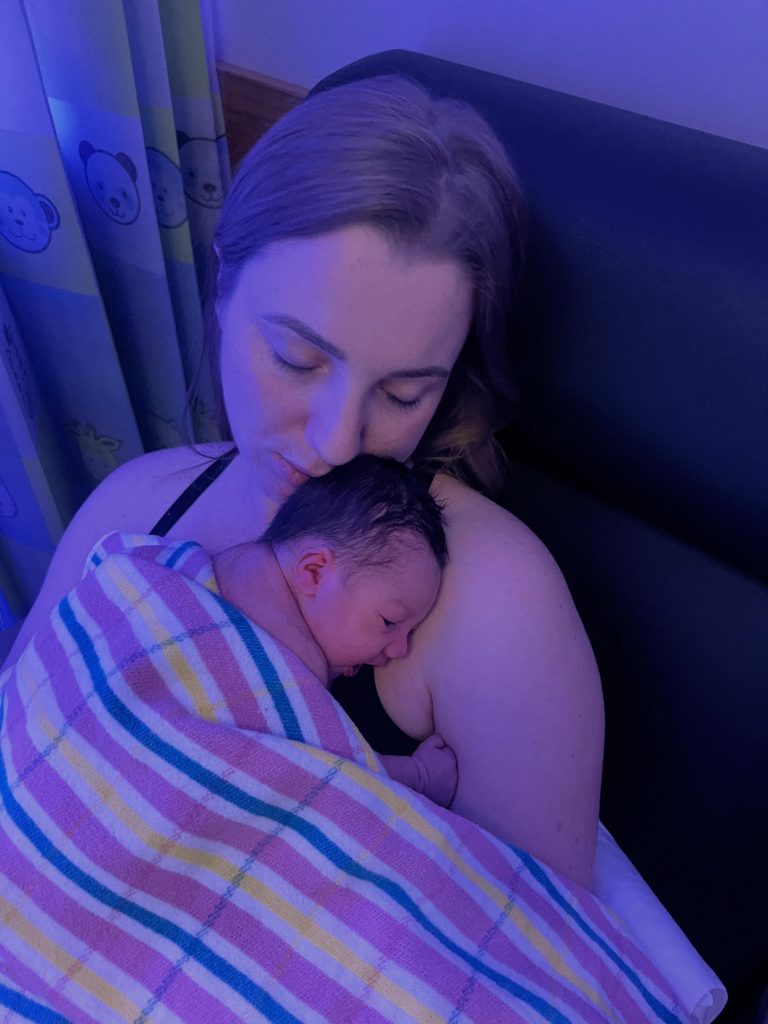
Freya, 31, lives in Melbourne with her husband and their five-month-old daughter Goldie. Freya works as a doctor training in paediatric rheumatology and had attended “many hundreds” of births in her career as a paediatric doctor, an experience she says “coloured my fears a little bit about childbirth.”
Freya has polycystic ovarian syndrome and irregular cycles, so she and her partner expected conception might take time. Instead, it happened quickly. “The first sign that I had was my acne flared up really badly,” she recalls. “My boobs are a little bit sore, it’s a bit weird. And yeah, it was positive.”
Because of her clinical background, Freya knew from the outset that she wanted to deliver in a tertiary hospital with a NICU and ICU on site, with an obstetrician present at the birth. “If something needed to happen, an emergency caesarean, instrumental, I really wanted someone to be there,” she explains. She chose Dr Pip Costley, an obstetrician recommended by both her GP and several obstetric trainee friends, describing her as “pragmatic and evidence-based.”
Hyperemesis gravidarum
Freya’s pregnancy was dominated by severe hyperemesis gravidarum, beginning around seven weeks and lasting the entire pregnancy. “It really ruined my experience of pregnancy. I didn’t enjoy being pregnant at all,” she says. Despite being on three different anti-nausea medications and losing significant weight, Freya downplayed her symptoms to her obstetrician. “I think I probably could have used the services that they had – the on-call midwife, asking more questions, booking extra appointments – and I don’t know if I regret not doing that.”
She speaks candidly about the shame that so often accompanies hyperemesis gravidarum. “I thought I was just being weak… this is pregnancy nausea, everyone gets it.” She even admits the thought of ending the pregnancy crossed her mind at her lowest points, though she never seriously considered it. “The only thing that will work is one way or another not being pregnant anymore,” she remembers thinking, before adding, “I didn’t follow through with any of it.” Freya’s sickness only lifted the moment she gave birth. “It was like the second that placenta came out of me, I realised just how sick I’d been.”
A car accident at 34 weeks
On the very first day of her maternity leave, driving to a pregnancy massage, Freya was involved in a serious car accident. “Someone essentially T-boned me in my car… and then I was hit from the front,” she recalls. What followed was, in her words, “the worst hour of my life,” as she waited to confirm her baby’s heartbeat. “Before someone put an ultrasound probe on my belly and confirmed that there was still a heartbeat was just the worst hour of my life.” Freya sustained a thumb injury requiring a splint for four months and underwent CT scans, which she found distressing given her knowledge of paediatric oncology. “It doesn’t increase risk of childhood cancers significantly, but it does increase the risk… I just felt sad about that.”
Spontaneous labour at 35 weeks
Just days after the accident, Freya’s waters broke in the night. “I thought I’d wet myself,” she laughs. Because she was premature, she went straight to hospital for monitoring rather than labouring at home, travelling by Uber “sitting on a towel.”
Freya’s obstetrician broke the remainder of her waters to help move things along given the premature baby’s reduced resilience for a lengthy labour. Freya tried a yoga ball, TENS machine and nitrous oxide, but found little relief. “During the contraction I felt nothing. And then as soon as the contraction was over, it was like I was drunk out of my mind.”
Eventually, augmentation was recommended, and Freya opted for an epidural. “I felt like I’d failed a bit, which is so weird,” she admits, “but then the second the epidural went in, it was the best thing I’d ever done.” Ironically, because she wasn’t pressing her patient-controlled epidural button correctly, she began feeling significant pain again – which turned out to be a blessing in disguise. “She said, I’m just going to examine you quickly… you’re 10 centimetres,” Freya recalls, having been only four or five centimetres less than an hour earlier.
Goldie was born after just three or four contractions of pushing. “She came out and cried and didn’t need any resuscitation,” Freya says with relief. Because of her prematurity, a paediatrician was present, but the couple were given an hour of skin-to-skin before Goldie was taken to special care. “It felt like no time at all.”
A three-day NICU stay and formula feeding
Freya credits her clinical knowledge with easing some of the anxiety of a special care stay. “I trusted the doctors and nurses there… I knew what was going on while I wasn’t there.” Goldie required formula supplementation initially due to prematurity and jaundice risk, something Freya found emotionally difficult despite her professional familiarity with the practice. “The second she came out of me, I just had this almost biological need to feed her with my milk.”
A painful breastfeeding journey and undiagnosed tongue tie
Breastfeeding proved to be Freya’s toughest postnatal challenge. Despite antenatal preparation, lactation consultant appointments and online courses, feeding was “excruciatingly painful” for three months. “I’d have blood blisters on my nipples, the skin would be pulled off, they were just red, raw, scabbed.” It wasn’t until her fifth lactation consultant visit that a tongue tie was identified and treated. “It was night and day,” Freya says. Now, at five months, Goldie is exclusively breastfed and pain-free.
Postnatal anxiety and support
Freya also opens up about seeking support from a perinatal psychiatrist for anxiety linked to guilt over the accident and Goldie’s prematurity, alongside increasing her SSRI dose and undertaking talk therapy. “I think I just wanted something to go to plan,” she reflects.
Freya’s story is a powerful reminder that even medical professionals can feel unprepared, frightened and guilty during pregnancy and birth – and that vulnerability, honest communication and the right support can turn a complicated start into a positive, healing experience.

Topics Discussed
premature birth after car accident, perinatal anxiety, Premature birth, Tongue-tie, Hyperemesis Gravidarum (HG)
Episode Sponsor
Today’s episode is brought to you by Nutra Naturals.
Made from Australian grass-fed beef and pasture-raised chicken bones, Nutra Naturals’ award-winning bone broths are slowly cooked and concentrated into either a rich paste or convenient powder. So you get the rich flavour and naturally occurring collagen protein you’d expect from a traditional homemade bone broth – without spending hours in the kitchen.
Plus there’s added Zinc and B Vitamins too! No preservatives, no fillers, no nasties. Just clean wholefood ingredients that make healthy eating feel effortless. And that is really what we are all after isn’t it.
The range starts from $34.95 and you can shop online at nutranaturals.com.au. Use the code AUSBIRTHSTORIES at checkout to get 20% off.
But be quick, this offer is only available until the 18th of September 2026 and cannot be used on bundles or with any other offer.

-
Birth Meditations
$49.00Narrated by Sophie Walker, these soothing and informative meditations help you feel supported and confident around birth.


